American consumer electronics brand Sonos is about to release a new soundbar, the Sonos S59, dubbed Gambit. The new soundbar is set to hit the market sometime around September 2026.
Details of the new soundbar were leaked from US Federal Communications Commission (FCC) filings and reported by Bloomberg. According to the specifications in the leaked documents, the S59 Gambit appears to be an upgrade to the Sonos Gen 2 soundbar, released in 2021.
Below, we have compiled a detailed review of the upcoming Sonos soundbar, with some of the features you can expect to see.
Expect features of the Sonos S59 Gambit soundbar
The Sonos Gambit soundbar is expected to come with the following features, some of which have already been confirmed by the leaked FCC filings:
1. 6 GHz Wi-Fi support
One of the major upgrades the new Sonos soundbar will have is a better wireless performance. According to the leaked FCC filings, the S59 Gambit has a tri-band Wi-Fi system that supports 2.4GHz, 5GHz, and the ultra-fast 6GHz.
Wi-Fi 6 support will be a huge upgrade over the Sonos Beam Gen 2 soundbar, which only supports 2.4 GHz Wi-Fi.
2. Bluetooth audio streaming
The new soundbar is likely to offer Bluetooth streaming, which is not available on the Sonos Beam Gen 2.
While the leaked FCC filings have not explicitly confirmed this, FCC test reports indicate that the new soundbar has a standard Bluetooth controller capable of audio streaming.
Additionally, the newer Sonos Arc Ultra soundbar offers Bluetooth audio streaming. Therefore, it is very likely that this feature will also be available on the Gambit.
3. A compact form factor
A leaked image from the Sonos FCC filings has confirmed that the new soundbar will have a compact design, with a width of around 650 mm (25.6 inches) and a depth of 100 mm (3.94 inches).
What’s interesting about the S59 Gambit’s design is that its dimensions are nearly identical to those of the Sono Beam Gen 2 soundbar, which measures 651 mm (25.63 inches) x 100 mm (3.94 inches) x 68 mm (2.68 inches).
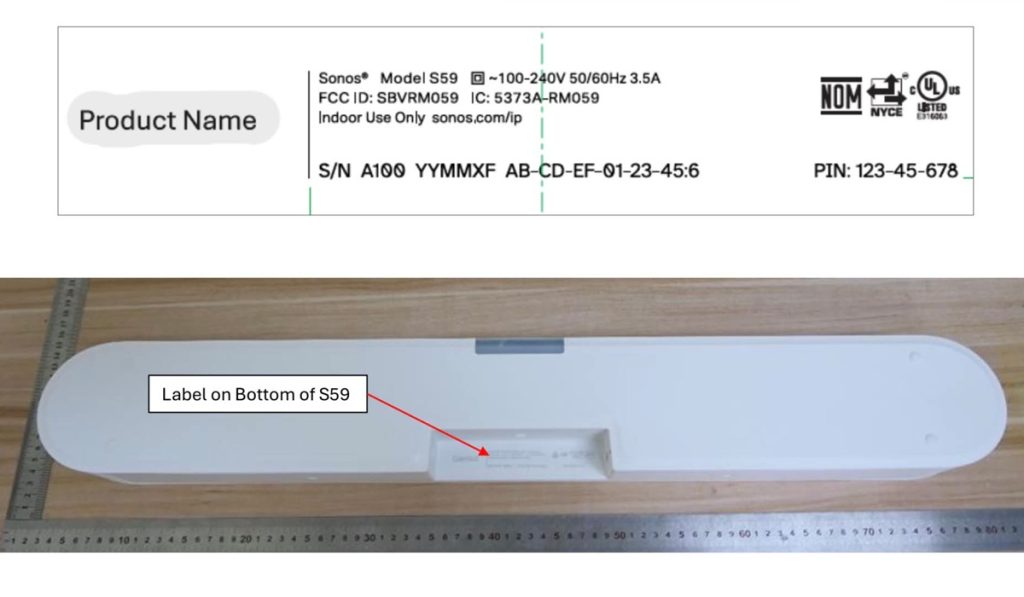
The identical dimensions are one of the main reasons the Sono S59 Gambit is being considered by many as a replacement for the Sono Beam Gen 2.
4. Potentially higher power output
The S59 Gambit soundbar could also come with a potentially higher-power-output upgrade. While the actual output rating is unknown, the leaked FCC filing documents indicate that the soundbar has a power input of 3.5 A, compared to the Gen 2’s 1 A.
The significantly higher power input could be a result of upgraded internal amplification. As a result, the soundbar is likely to deliver a greater acoustic potential, with higher volume, deeper bass, and improved audio clarity.
However, it is worth noting that the higher power input could be due to the tri-band Wi-Fi system or newer audio processing units.
5. Physical Dolby Atmos channels
The current leaks from FCC filings do not reveal how Sonos will implement Dolby Atmos technology in the S59 Gambit soundbar. However, it is likely to use physical Dolby Atmos rather than the virtual Dolby Atmos technology currently used in Gen 2.
The likelihood of a physical Dolby Atmos implementation stems from the fact that both the Sonos Arc and the flagship Sonos Arc Ultra use physical up-firing drivers to create a Dolby Atmos height effect.
One Reddit user has also suggested that the Gambit soundbar may come with Sound Motion transducer technology. However, that is a bit of a stretch, as the technology is only in use on the Sonos Arc Ultra soundbar.
Sonos Gambit soundbar – To buy or not?
Based on leaked and expected features, the Sonos S59 Gambit soundbar will come with several upgrades. This will make it a significantly better option compared to the Sonos Beam Gen 2 or the Sonos Ray soundbars.
It is unlikely that the new soundbar will surpass the Sonos Arc Ultra, but it may well be worth the money depending on the retail price.
Currently, there is no information on how much the new soundbar will retail for. However, the Sonos Beam Gen 2 currently retails at $499, and the Gambit is likely to launch within this mid-budget range, albeit slightly higher than the Gen 2.