Skyworth and TCL are two of the most common TV brands you will encounter on the market. Both offer decent TV models packed with quality features at budget-friendly to mid-range prices.
However, deciding which brand to purchase can be frustrating, especially when considering two TV models with closely matched features.
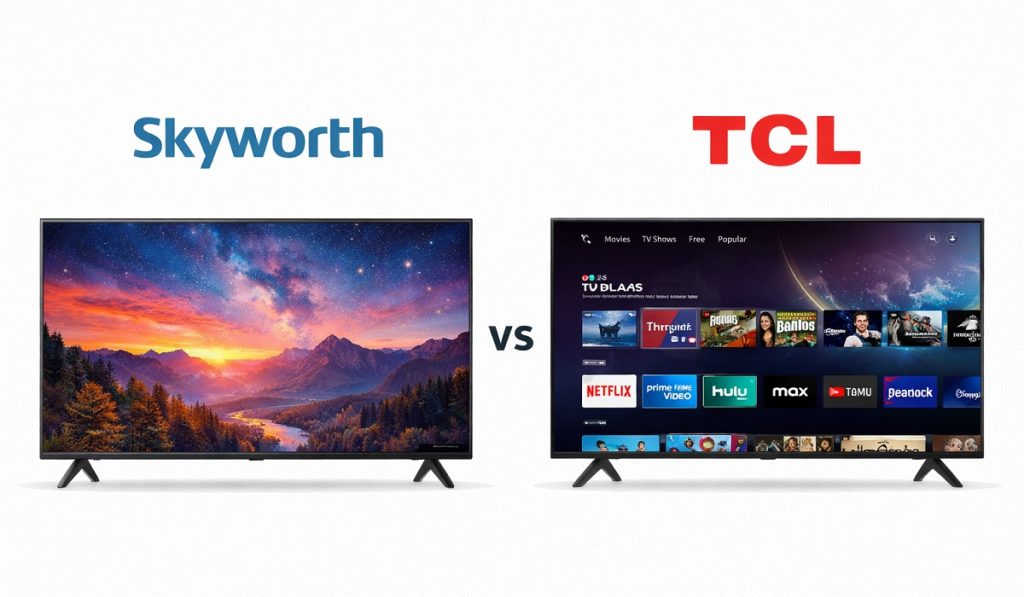
In this guide, we will compare key features of Skyworth and TCL TVs, making it easy for you to decide which brand is worth your money.
Skyworth vs TCL – features
The features offered are among the top factors to consider when choosing between Skyworth and TCL TVs. Below is a side-by-side comparison of various features and specifications of these two TV brands.
Display technologies
TCL offers a diverse range of TV display technologies, including its 2025 flagship technology, QD-Mini LED (Quantum Dot Mini-LED). The technology combines Quantum Dot (QLED) with Mini LED, resulting in vibrant colors, deeper blacks, high contrast, and peak brightness in its panels.
TCL also offers other display technologies, including QLED, Mini LED (where it is a pioneer, having launched the world’s first mass-produced Mini-LED TV), full array local dimming, and 4K HDR LED.
Likewise, Skyworth offers a diverse range of display technologies, including QLED, Mini-LED, LED, and LCDs. It also specializes in OLED (organic light-emitting diode), where it is a pioneer, having launched the first OLED TV in 2013.
Image features
When comparing image quality, both brands offer a wide range of features, including HDR support and Dolby Vision. However, TCL offers comprehensive HDR support, including HDR10+ and Dolby Vision, across many of its TV models.
Skyworth also supports HDR10+ and Dolby Vision, but these features are most common on high-end TV models.
Both Skyworth and TCL make use of image processing technologies to improve picture quality.
TCL uses an AiPQ processor (an AI-based processor) for image processing. The standard AiPQ processor is common in entry-level TCL TV models, and the advanced AiPQ Pro and Ultra processors are employed in high-end models.
Skyworth uses the Chameleon Extreme 2.0 picture engine (also an AI-based processor) across many of its TV models. However, some high-end models feature an S AI image processor, an AI-based neural processing unit.
Brightness is another aspect of image quality you can consider when comparing TCL and Skyworth TVs.
TCL offers superior brightness, with many of its HDR TVs reaching peak brightness of between 1,000 and 3,000 nits. However, some higher-end models can achieve higher peak brightness levels, including the 2026 flagship TV mode, which is marketed at 10,000 nits.
Skyworth, on the other hand, offers a typical brightness of around 200 – 400 nits, with specialized TV models like the Skyworth S1 Clarus Outdoor TV reaching up to 3,000 nits.
Sound quality
TCL TVs offer decent sound quality, with many models featuring Dolby Audio and Dolby Atmos. Some high-end TCL TVs also support advanced audio features, including Dolby Atmos FlexConnect, an Onkyo sound system, and Audio by Bang & Olufsen.
Skyworth also offers decent audio, with several of its TVs featuring Dolby Audio. However, Dolby Atmos is mainly limited to higher-end Skyworth TVs.
Operating system and smart TV features
Both Skyworth and TCL offer a wide variety of Smart TV models. Skyworth primarily uses the Android TV platform, with the newer TV models featuring the Google TV interface.
With the Skyworth Smart TVs, you can access several smart TV features, including built-in Chromecast, Google Assistant & Google voice search, Live TV, content curation, personalized profiles, and access to thousands of apps, including streaming apps, from the Google Play Store.
TCL also primarily uses the Android TV platform, with newer smart TV models equipped with the Google TV interface. However, some of its smart TV models also run on the Roku OS.
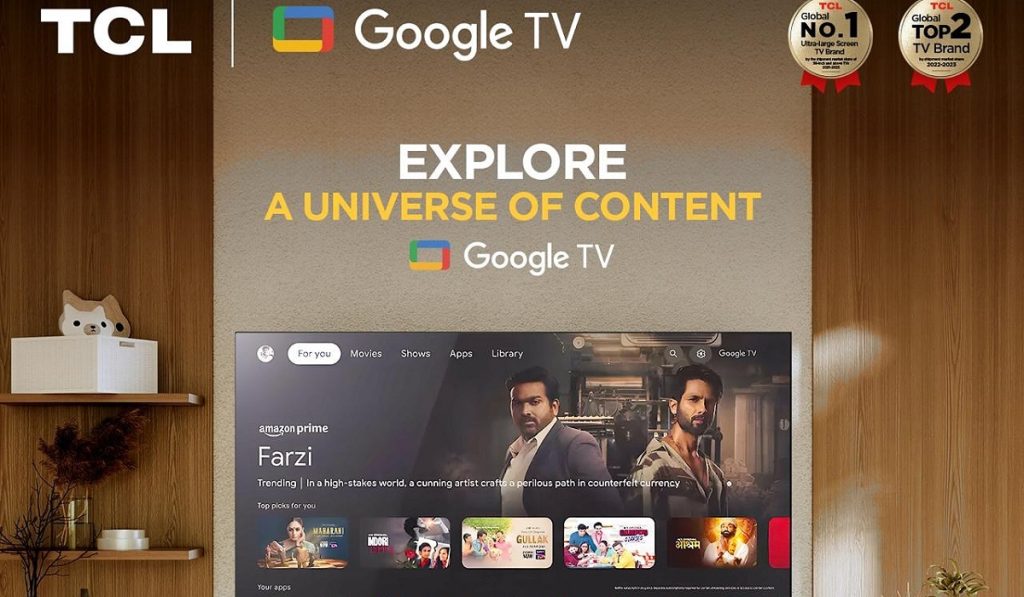
Like with Skyworth, you can access a range of smart TV features on TCL TVs. These include built-in Chromecast or Apple AirPlay, voice search and control with Google Assistant or Alexa, Live TV (via Google TV or The Roku channel), and access to streaming apps or channels (Roku).
Skyworth vs TCL – Performance
TCL offers superior performance, starting with its advanced QLED, Mini-LED, and QD-Mini-LED display panels, which deliver high brightness. The AiPQ processor also helps optimize image and sound quality, resulting in a better viewing experience.
TCL also offers superior gaming performance, with several of its TVs featuring a gaming mode with low-input latency and virtual refresh rates of 120/144 Hz, and some models reaching up to 240Hz with a gaming accelerator.
Skyworth also delivers decent performance, with its QLED, OLED, and QLED+ display panels offering competitive image quality. Additionally, it uses various AI-based image processors and chipsets to enhance image quality and performance.
Regarding gaming, Skyworth may not be on par with TCL, but some of its TV models offer gaming features such as variable refresh rate (VRR) and low input lag, which improve gaming performance.
Skyworth vs TCL – warranty support
Both Skyworth and TCL offer warranties for their TVs. TCL typically offers a 3-year warranty for most of its TV models, which includes either a 2-year full warranty and a 1-year limited warranty (parts only) or a 1-year full warranty and a 2-year limited warranty.
However, some high-end TCL TV models can come with a 5-year warranty, comprising a 3-year full warranty and a 2-year limited warranty, or a 2-year full warranty and a 3-year limited warranty.
Skyworth, on the other hand, usually offers a 2-year warranty for most of its TV models, with a few select models offering a 2+1-year extended warranty.
Skyworth vs TCL – Pricing
Both Skyworth and TCL offer a wide range of budget-friendly TV models and are among the top brands in the value-driven TV market.
TCL’s budget/mid-range TV models cost between $400 and $700, while higher-end and larger-screen models cost $700 to $1100.
With Skyworth, on the other hand, budget-friendly and mid-range TVs cost between $300 and $600, while many higher-end and large-screen models cost less than $1000.
A good example of the pricing differences between Skyworth and TCL is the comparison between the Skyworth 75UD6300 and the TCL 75S453.
Both are 75-inch 4K smart TVs with slightly similar features and specifications.
However, the Skyworth 75UD6300 smart TV costs $539.99, while the TCL 75S453 model costs $759.69.
Who makes Skyworth and TCL TVs?
Both Skyworth and TCL TVs are manufactured in-house by Chinese companies.
Skyworth TVs are manufactured by Skyworth Group Co., Ltd., a Chinese multinational electronics company based in Shenzhen, China. The company, founded in 1988, specializes in manufacturing TVs, monitors, set-top boxes, refrigerators, and other electronics.

In addition to making Skyworth TVs, the Skyworth Group is an original equipment manufacturer that supplies TVs and TV components to other brands, including Metz, Sinotec, CooCaa, and Philips.
TCL TVs are manufactured by TCL Technology Group Corp., one of the world’s largest TV manufacturers. The company, founded in 1981, is based in Huizhou, Guangdong, China.
TCL Technology Group specializes in manufacturing smart TVs and other electronics, such as mobile devices, soundbars, home appliances, and display panels.
Additionally, through its subsidiary, TCL CSOT, the company also manufactures TV display panels for other brands, including Samsung, Xiaomi, Haier, Sony, and Changhong.
Top alternatives to Skyworth and TCL TVs
You can consider other TV brands if you are looking for alternatives to Skyworth and TCL.
Hisense, another Chinese-made TV brand, is one of the top competitors to Skyworth and TCL, especially in the Mini-LED and LCD market segments.
Haier is another excellent option for both TV brands if you are looking for something in the budget-to-mid-range category. Other budget/value-driven alternatives include Xiaomi, Vizio, Konka, Onn, Devant, Roku, Panasonic, and Sharp TVs.
If you are looking for a premium alternative, LG, Sony, and Samsung are good options, especially in OLED, QLED, and Mini-LED.
Which TV brand is worth your money?
Both Skyworth and TCL are good brands if you are looking to buy a TV.
However, TCL has an edge over Skyworth in performance and features, with its QLED, Mini-LED, and QD-Mini LED display panels offering better brightness, contrast, and, consequently, better image quality.
TCL also uses an advanced AI image processor, and most of its TV models feature Dolby Vision and Dolby Atmos, which enhance the viewing and listening experience.
Additionally, TCL offers better gaming performance, with several models featuring a gaming mode and other gaming features, such as higher refresh rates and low-input lag mode.
Skyworth, on the other hand, is an excellent choice if you are looking for better value, with its QLED and OLED TV models offering high image quality at lower prices than TCL.
Additionally, Skyworth’s QLED+ TVs offer excellent performance, with better brightness, color accuracy, and faster refresh rates, and are more durable and long-lasting than standard QLED TVs.