Paramount Global (which recently merged to Paramount Skydance) owns Pluto TV. It (Pluto TV) is one of several streaming services that let you watch live TV and on-demand content for free.
In this guide, we will delve deeper into Pluto TV’s ownership and business model. We will also assess the legitimacy and legality of the free streaming service.
A brief history of Pluto TV’s ownership
Pluto TV was founded on March 31, 2024, by Tom Ryan, Nick Grouf, and Ilya Pozin, becoming one of the early pioneers of the free, ad-supported streaming industry.
During its early years, it operated as an independent startup, with the streaming service owned by Pluto Inc.
Around 2014, the company raised $13 million in Series A funding, with top investors including Luminari Capital, Great Okas Venture Capital, Universal Music Group, Chicago Ventures, and United Talent Agency.
In 2016, the company secured $30 million in Series B funding, with participation from new investors, including Sallfort PrivatBank and Scripps Network Interactive. Existing investors, including Luminari Capital, USVP, Thirdwave Capital Partners, and Chicago Ventures, also participated in the funding.
The streaming platform continued operating as an independent startup until 2019, when Viacom acquired it for $340 million.
Who owns Pluto TV in 2026?
As of January 2026, Paramount Skydance owns Pluto TV.
After Viacom acquired the streaming platform, it merged with CBS to form ViacomCBS. Consequently, Pluto TV became part of the ViacomCBS portfolio.
Then, in 2022, Viacom rebranded to Paramount Global, with Pluto TV becoming part of the new company’s portfolio under the Paramount Streaming division.

Pluto TV’s ownership status would change again in 2025, when Paramount merged with Skydance. Following the merger, the streaming platform became part of the newly formed company’s (Paramount Skydance) Direct-to-Consumer division.
How does Pluto TV operate?
Pluto TV operates on a free, ad-supported streaming television (FAST) model. Its mode of operation is similar to that of traditional pay-TV services, offering live TV channels and on-demand content to users.
However, the significant difference with Pluto TV is that it doesn’t charge a subscription fee. Instead, it offers ads within its content, generating revenue when users watch advertisements.
Pluto TV also differs from traditional subscription-based pay-TV and streaming services in that it does not require account registration. Instead, users can open the Pluto TV app or website and start streaming content immediately.
However, users can still register for an account, which allows them to personalize their viewing experience through features such as personalized favorites, watchlists, and cross-device continuity.
What content is offered on Pluto TV?
Pluto TV offers a vast collection of content, including live channels and on-demand programming.
Starting with the live channels, the streaming platform offers over 250 channels across various genres, including news, local broadcast, movies, dramas, reality TV, lifestyle, sports, and more.
The platform also has an extensive library of on-demand content, with over 20,000 watch hours of movies, TV shows, Pluto Originals, reality TV, documentaries, and more.
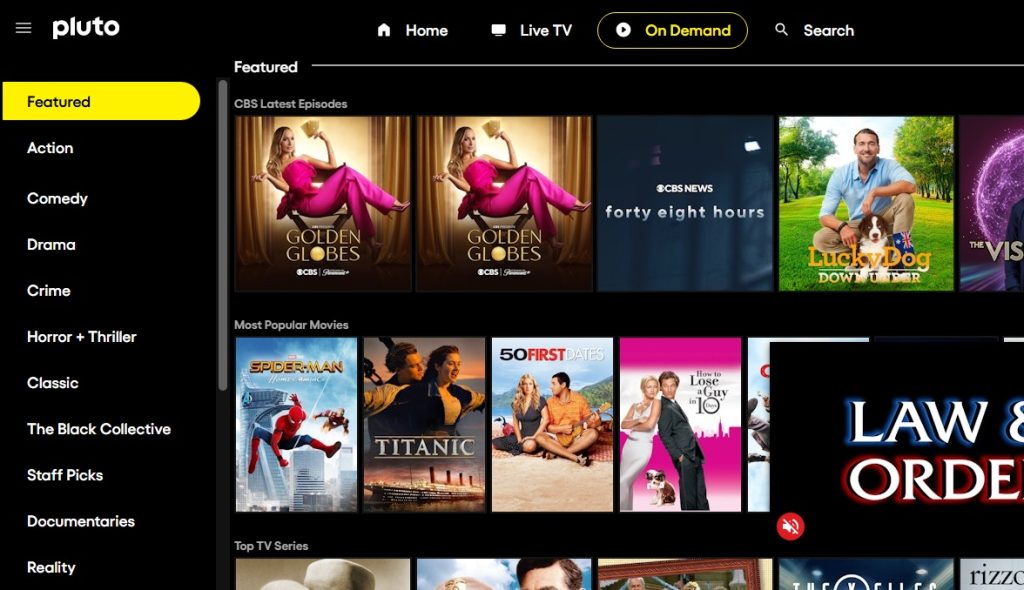
Pluto TV’s content is licensed from over 400 media partners, including its parent company (Paramount). Other major distributors include Sony Pictures, Warner Bros. Discovery, BBC Studios, FilmRise, MGM, Fremantle, All3Media, Nelvana, CBS, and more.
Is Pluto TV a legal streaming service?
For some people, “free streaming” is a red flag that often means unlicensed or pirated streaming services. However, Pluto TV is neither of those; it is a legitimate service that offers licensed content for free.
As already mentioned, the platform offers a variety of content licensed from legitimate distributors, many of whom also supply content to subscription-based pay-TV and streaming services.
Pluto TV’s ad-supported business model is why the platform can offer content for free, without subscriptions.
Is Pluto TV’s business model profitable?
The idea of offering content for free in exchange for watching ads may not seem profitable. However, Pluto TV’s business model is, in fact, very profitable.
By offering free content, Pluto TV attracts large numbers of users. In 2023, Paramount reported that the platform had 80 million monthly active users, a figure that rivaled popular subscription-based streaming services like Netflix and Hulu.
The high number of users translates into more ad views and, consequently, more revenue. Indeed, Pluto TV surpassed the $1 billion annual revenue milestone in 2021 and is projected to reach over $3 billion in annual revenue by 2029.