BBC Research & Development has been testing “low-latency” delivery on BBC iPlayer’s beta channel and is expanding the trial. This will include more hours, more home networks, and a much wider set of devices.
The trial began in earlier phases (timed for big events like Wimbledon and Glastonbury). It has now entered a new phase that broadens compatibility and stretches the test hours so engineers can see how low-latency streams behave in real life.

The BBC iPlayer low-latency streams in detail
You already know streaming often lags behind broadcast. Also, typical iPlayer live streams have sat in the region of tens of seconds behind linear TV (commonly 40 seconds in many measurements).
Broadcast TV, by contrast, uses different transport paths and often reaches viewers in 8 to 10 seconds. That gap matters for sport, live news and any real-time social experience.
The BBC wants the streamed feed to be “in the moment” like broadcast, while keeping the reliability and quality viewers expect from iPlayer. That’s the precise problem the trial aims to solve.
So, their trial of low-latency streaming on iPlayer beta earlier this year has now moved into a wider testing phase. The expansion increases the number of supported devices and extends the hours that the low-latency feed runs, so the trial gathers richer data across different homes, Wi-Fi setups and ISPs.
If you live in England or Scotland and run iPlayer’s beta mode on a supported device, you may see the low-latency BBC Two live stream during the trial hours.
Chris Poole, Lead R&D engineer at BBC Research & Development, framed the expansion plainly:
“This next phase will allow us to measure more precisely how well low latency streaming performs outside of our lab and in people’s homes, across different networks and conditions. It’ll also help us to understand what it takes to deliver live content online as fast and reliably as broadcast.”
How the BBC iPlayer low-latency streaming will work
Previous adaptive streaming that iPlayer uses (DASH/HLS) packs video into relatively large segments and buffers several seconds to ensure smooth playback, especially across poor networks.
The new low-latency streaming uses CMAF chunked segments or low-latency variants of HLS/DASH, plus smarter player behaviour. Hence, the player can begin presenting audio and video with much less pre-buffering.
The stream sends smaller parcels of media more frequently, and the player stitches them together.
When safe, iPlayer will also slightly speed up playback for a short moment to catch up to the target latency if it falls behind during live events.
BBC iPlayer low-latency streaming supported devices
As mentioned earlier, the device set for this trial has grown. Below is the device list currently supported:
Devices and boxes:
They include the following:
- Fire TV Edition 4K (2022, FVP)
- Select YouView and BT TV boxes
- Sky Glass first-generation devices
Samsung
These are the Samsung TV models with these prefixes and suffixes currently supported:
- QE********UXXU, UECU7100KXXU, UECU7110KXXU, CU8000, CU8500, QE********ATXXU, QE********AUXXU, QE******BAUXXU, QE**03BAUXXU, QE**01BAUXXU,
Sony, LG, Toshiba, Hisense and other TV brands
The following are supported:
- Sony (selected XR and XR-series): XR-A95K, XR-X90K, XR-X94K, XR-A90K, XR-A80K, XR-A84K, XR-A75K, XR-Z9K, XR-X95K, XR-X90S, XR-X94S, KD-X80K, KD-X81K, KD-X85K, KD-X89K.
- LG: The expanded BBC iPlayer low-latency streams list includes multiple OLEDxxCxxLA. There is also UQ9100 / UQ9000 / UQ8100 / UQ91006 model ranges in the list.
- Toshiba and Hisense: Large sets of 43UV/50UV/55UV/65UV and QV/2E/4E series models are included.
- Other brands: Dozens of models across smaller manufacturers are in the listing too.
Note: The device list above reproduces the model codes published with the expanded trial. For exact model match, compare the code in your TV’s Settings > About or Device Info with the model strings on the BBC list.
How to opt into the BBC iPlayer low-latency streams trial
Use the following procedure:
- Open iPlayer on your TV or streaming box.
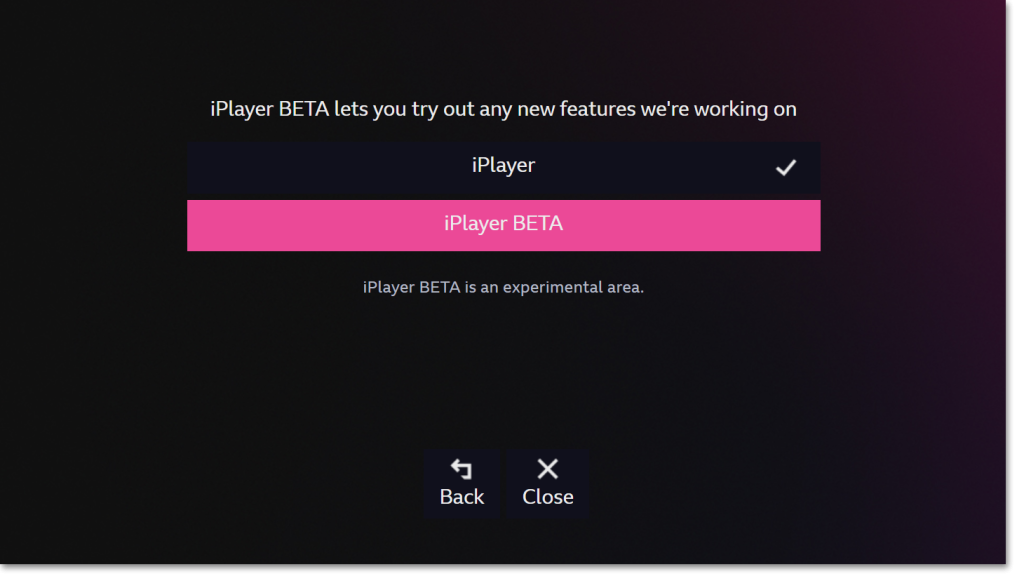
- Go to Settings > look for iPlayer beta and switch it On
- Set your iPlayer region to England or Scotland. The trial currently excludes Wales and Northern Ireland on this wave.
- Tune to BBC Two live during the trial hours. The expanded phase runs extended hours. That’s roughly 08:00 to 22:00 BST, though earlier pilot windows were shorter.
Tip: Use a wired Ethernet connection or a strong 5 GHz Wi-Fi connection, close heavy background apps and, where possible, prefer modern Wi-Fi hardware. Those simple steps give the low-latency player the best chance to hold the reduced buffer without stalls.
What you’ll notice with the new BBC iPlayer low-latency streams
If your connection and device can sustain low latency, you’ll notice faster reactions to live moments. These include applause, a goal, a line call, and you’ll be much nearer the timing of broadcast viewers. That reduces spoilers on social feeds and makes participation on live chats, betting, cheering in the bar feel synchronized.
You may not see perfect parity with broadcast just yet. The BBC has said that even the promising low-latency streams still vary because of ISP congestion, Wi-Fi instability and device differences.
On very weak networks you might see the player fall back to a conventional higher-latency mode to preserve picture quality.